Fiddler Crabs are in the family Ocypodidae, along with Ghost Crabs and Mangrove Crabs.
Subfamilies
Within the Ocypodidae, there is some uncertainty as to the relationship between fiddler crabs and ghost crabs, such that at this time fiddler crabs are not all within a single named taxon to the exclusion of non-fiddler crabs. Fiddler crabs are split between two subfamilies: (1) Gelasiminae and (2) Ucinae or Ocypodinae, depending on the hypothesis of the relationship between this subset of fiddler crabs and ghost crabs one believes. If the relationship between all fiddler crabs is resolved such that they can be placed in a single group to the exclusion of ghost crabs, that group would be the single subfamily, Ucinae.
Under current nomenclature, the subfamily Gelasiminae contains nine genera within two major subclades (two tribes within a single redundant supertribe). If all fiddler crabs are later found to be part of a single monophyletic clade, Gelasiminae would be eliminated as a subfamily in favor or Ucinae, and this group would be represented soley by the supertribe Gelasimitae.
Under current nomenclature, the subfamily Ucinae contains two genera (which can be viewed as within a single tribe within a single supertribe). Depending on the precise relationship between fiddler crabs and ghost crabs, it is possible that this subfamily is invalid and a junior synonym for the ghost crab subfamily Ocypodinae. On the other hand, if all fiddler crabs are later found to be part of a single monophyletic clade, Ucinae would have priority as the name that represented the entirety of fiddlers (and thus eliminating the subfamily Gelasiminae).
Supertribes
Under the current taxonomic system of two subfamilies, the supertribes are unnecessary/redundant as each subfamily would contain only a single supertribe. These supertribes become more important if fiddler crabs are reduced to a single subfamily.
The supertribe Gelasimitae contains two tribes. Under current nomenclature it is redundant/identical in content with the subfamily Gelasiminae, but could serve an important nomenclatural purpose if fiddler crabs return to a single group in the subfamily Ucinae.
The supertribe Ucitae contains only a single tribe. Under current nomenclature it is redundant/identical in content with the subfamily Ucinae, but could serve an important nomenclatural purpose if Ucinae is expanded to include all fiddler crabs.
Tribes
Under the pair of subfamilies and/or supertribes, fiddler crabs can be split into three tribes. These tribes are likely to be stable even if the number of subfamilies changes.
The Gelasimini contains all of the fiddler crab genera found along the coasts and islands of the Indian Ocean and the central and western Pacific Ocean.
The Ucini contains the narrow-front fiddler genera found along the American coasts and the single genus found on the eastern Atlantic Ocean. It is redundant/identical with the supertribe Ucitae, but included for rank symmetry.
Genera
Until recently, fiddler crabs were generally considered to belong to a single genus, Gelasimus for most of the 19th century, Uca for the 20th and early 21st. Shih et al. (2016) divided fiddler crabs into eleven genera, all of which had previously been considered subgenera. These genera fall into three main groups represented by the tribes described above.
This monotypic genus consists of the single species Afruca tangeri. It is the only species found in the eastern Atlantic Ocean, along the western coast of Africa and the southeastern edge of Europe.
Gelasimus was considered to be the primary fiddler crab genus for most of the 19th century, until it was shown that Uca had priority (Rathbun 1893). Starting toward the end of the 20th century it was used as a subgenus of Uca. It returned to genus status when fiddler crabs were separated into multiple genera (Shih et al. 2016).
The genus Leptuca represents one of the two broad-front American genera which make up the tribe Minucini. The relationships between these genera has been a little unclear as a number of species have been moved back and forth between them as our systematic understanding of the groups has been refined.
The genus Minuca was originally erected as a subgenus to represent the broad-front fiddlers (as a contrast to the narrow-front species). It now represents one of the two broad-front American genera which make up the tribe Minucini. The relationships between these genera has been a little unclear as a number of species have been moved back and forth between them as our systematic understanding of the groups has been refined.
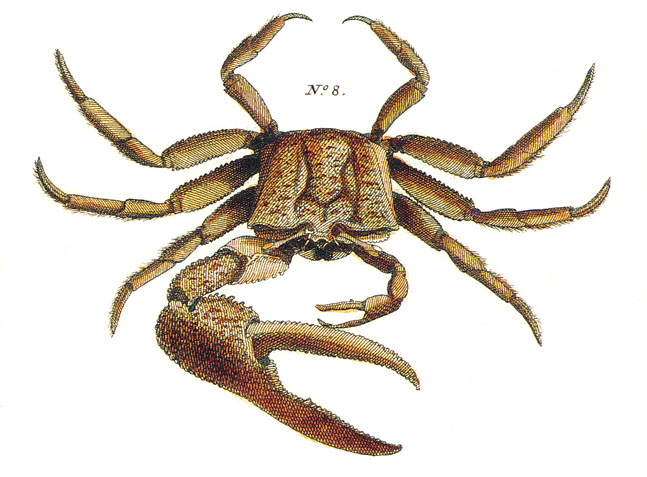
The genus Uca has a complicated history. The earliest description of the type species of Uca is from a drawing in Seba (1758), which he called Cancer uka una, Brasiliensibus (shown below).
A number of authors subsequently used this same picture as a basis for naming the species (Manning & Holthuis 1981). Cancer vocans major Herbst, 1782; Ocypode heterochelos Lamarck, 1801; Cancer uka Shaw and Nodder, 1802; and Uca una Leach, 1814, are all objective synonyms, because they are all based on the picture and description from Seba. Because of this, the official type specimen of the genus Uca is Cancer vocans major. The earliest description of this species based on actual specimens and not on Seba's drawing was Gelasimus platydactylus Milne-Edwards, 1837.
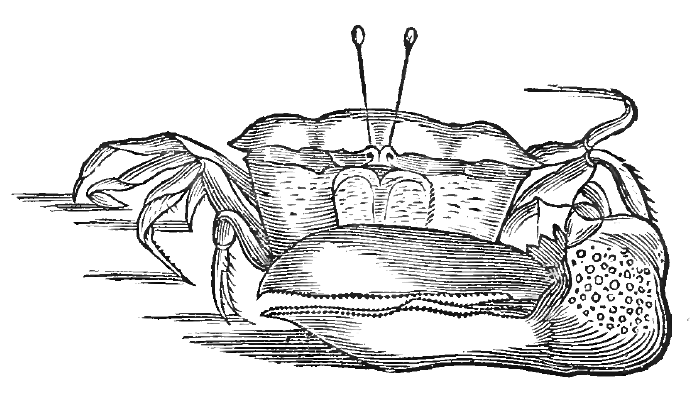
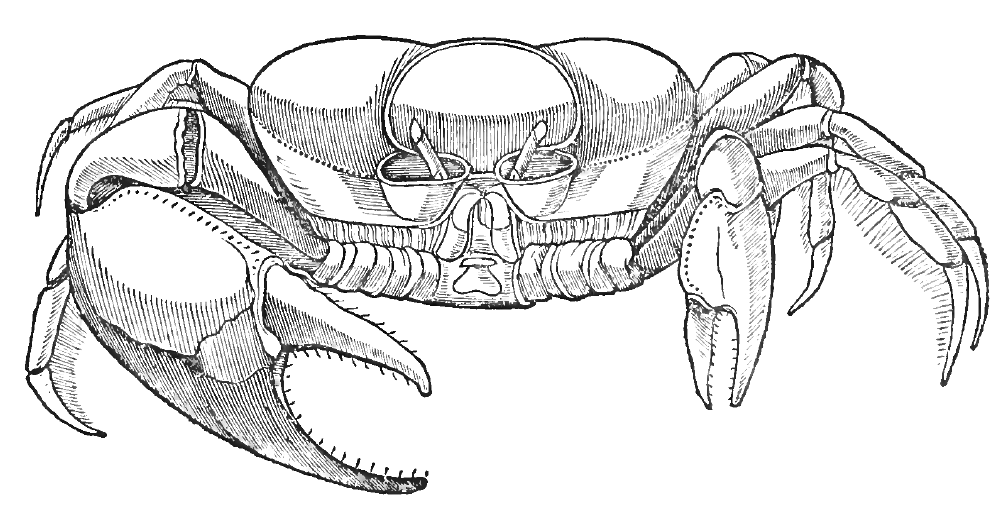
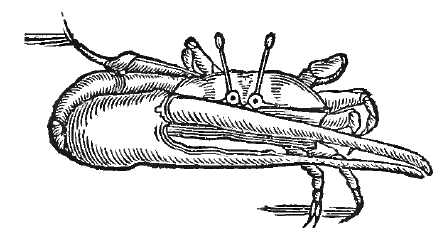
As an aside, Seba's name, Cancer uka una comes from the nomenclature of Marcgrave (1648), who mispelled “uça una” as “uca una”. Not only did Seba copy the mispelling, but he applied it to the fiddler crab instead of the mangrove crab (which is today called Ucides) to which Marcgrave applied the name (see below). Latreille's (1817) proposal of the generic name Gelasimus for fiddler crabs was so that Uca could be applied to mangrove crabs; as this was an invalid proposal, Uca is retained for fiddlers, despite being due to a pair of errors Tavares (1993).Oldest known drawing of a fiddler crab (Marcgrave 1648). He labeled it “Maracoani”, and it represents the namesake of the species Uca maracoani.The drawing actually labeled “Uca Una” by Marcgrave (1648) is not a fiddler crab. Today this species is known as the mangrove crab Ucides cordatus.The other fiddler crab drawing found in Marcgrave (1648), labeled “Ciecie Ete” (he also refers to a very similar species called “Ciecie Panema”). This figure is believed to most likely represent Uca thayeri.
For about 60 years, fiddler crabs were considered to be in the genus Gelasimus, until Rathbun (1897) showed that the abandonment of the older name Uca did not conform to zoological naming conventions. The type species of Uca was known as both Uca heterochelos and U. platydactylus, until Rathbun (1918) suggested the adoption of U. heterochelos as the valid name. Almost 50 years later, Holthuis (1962) pointed out that U. heterochelos was an objective junior synonym of U. major, thus the type species has been referred to as U. major ever since.
However, Bott (1973) discovered that there has been a universal misinterpretation of the type species; the species pictured by Seba is not the American species commonly referred to as U. major, but rather the West African/Portuguese species called U. tangeri (Eydoux, 1835) at the time. Correcting this error would have caused a somewhat painful change of names (Holthuis 1979, Manning & Holthuis 1981). The type species would still be called U. major, but would refer to the West African/European species rather than the American one; the American species, which has been called U. major since 1962, would be called U. platydactylus, a name not used since 1918.
To deal with this dilemma, the Society of Zoological Nomenclature officially designated the holotype of Gelasimus platydactylus as a neotype of Cancer vocans major (Holthuis 1979, ICZN 1983). The result of this decision is that we retain the names U. major for the American species and U. tangeri for the West African/European species. It also means that although U. tangeri is technically the species upon which the genus is named, U. major (Cancer vocans major) is still the official type species of the genus Uca.
Uca persisted as the sole genus of fiddler crabs until Shih et al. (2016) elevated eleven subgenera into separate genera. The genus Uca now represents the large, narrow-front fiddlers found in the Americas.
This monotypic genus consists of the single species Xeruca formosensis.
Subgenera
Prior to Shih et al. (2016), all fiddler crabs were considered to be a single genus and thus they were divided into subgenera within that genus. With the raising of the old subgenera to new genera, most of the new genera do not currently have subgenera. However, a few of the new genera have distinct enough subgroupings of species to warrant subgenera of their own.
Australuca was originally a subgenus of Uca. It was eventually abandoned when found to be a subset of another subgenus, btu with the Tubuca now considered a genus in its own right, Australuca can serve as a subgenus within it. All but one of the narrow-front fiddler species in this genus are restricted to Australia.
The subgenus Austruca, within the genus Austruca, contains the species often unofficially referred to as the lactea-species group. It is the four species identified by Crane (1975) as subspecies of Austruca lactea, along with additional species subsequently split from that group.
The subgenus Cuneatuca, within the genus Austruca, contains the two very small, closely-related species that Crane (1975) had combined into the single species Uca triangualris.
The subgenus Gelasimus, within the genus Gelasimus, contains the species often unofficially referred to as the vocans-species group. It is the six species identified by Crane (1975) as subspecies of Gelasimus vocans, along with an additional species subsequently split from that group.