Basic | Carapace | Major Claw | Abdomen
The following is an overview of some of the important or interesting morphological features of fiddler crabs. Features that are common to the genus or may be important phylogenetic characters are emphasized.
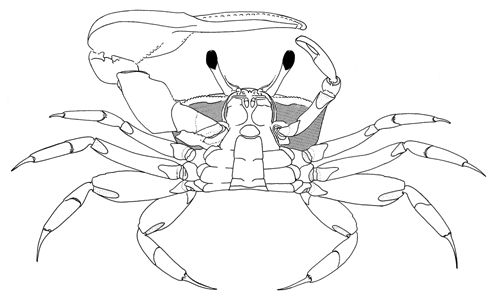
True crabs have five pairs of limbs (hence Decapoda). Four pair are used for walking: these are the legs or ambulatories. The two clawed limbs are called the chelipeds. On male fiddler crabs, the larger cheliped is the major cheliped, the smaller the minor cheliped. Female fiddler crabs have two small chelipeds that are similar to the minor cheliped in the males.

Figure modified from Crane (1975)
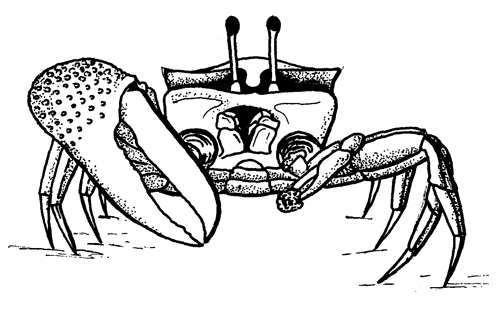
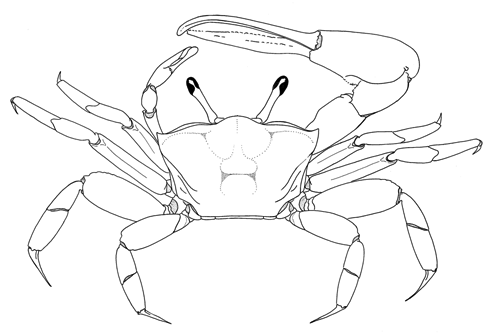
Fiddler crabs are often divided into two categories: broad-front and narrow-front. The front is the part of the carapce between the eyestalks.
|
|
| A narrow-front crab, Uca ornata | A broad-front crab, Uca terpsichores |
| Figures modified from Crane (1975) | |
The narrow-front subgenera are Uca, Tubuca, Australuca, and Gelasimus; the broad-front subgenera are Minuca, Leptuca, and Paraleptuca. (Exception: Uca tangeri has a broad-front, but is part of the subgenus Uca).
This feature, discovered by Guinot (1979), may be extremely important phylogenetic character. It consists of a pair of small ridges in the anterior part of the abdominal cavity, used to help hold the abdomen in place. These ridges are situated such that they align with the base of the telson.
|
|
| The abdominal cavity of Uca pugilator, showing the pleonal clasping apparatus | The abdominal cavity of Uca ornata. This species does not have the specialized abdominal structure |
This feature is found in the subgenera Minuca, Leptuca, and Paraleptuca. It is not found in Uca, Tubuca, Australuca, and Gelasimus. This character perfectly parallels front breadth.